
Choosing the right television technology can significantly enhance your viewing experience. As QLED and OLED TVs continue to lead the market, understanding their differences is crucial for making an informed purchase in 2024. Both technologies offer unique features, but selecting the right one depends on your preferences, viewing environment, and budget. This comprehensive guide will navigate the differences in technology, performance, and suitability for various use cases.
QLED, or Quantum Dot Light Emitting Diode, is Samsung’s proprietary technology that enhances display brightness and color using quantum dots. These dots don’t emit their own light; instead, they’re illuminated by a backlight, which helps produce vibrant colors and superior brightness levels.
QLED TVs incorporate a layer of quantum dots over an LED panel. These dots respond to the LED light to produce precise colors, offering excellent brightness levels even in brightly lit rooms.
Among the advantages of QLED are exceptional brightness and a wide color spectrum, while its drawbacks include limited viewing angles and less deep black levels compared to OLED. In 2024, Samsung maintains a strong hold on the QLED market with new releases offering enhanced features, while TCL and Hisense also present competitive options.
On the other hand, OLED, or Organic Light Emitting Diode, represents a cutting-edge technology where each pixel emits its own light, eliminating the need for a backlight, which results in impressive image quality with deeper blacks and superior contrast.
OLED panels consist of organic compounds that emit light when an electric current is applied. Each pixel functions independently, delivering accurate color-matching and deep contrast.
OLED pros include perfect blacks, wide viewing angles, and thinner designs, while cons consist of potential burn-in over time and generally higher costs. LG remains a leader in OLED technologyin 2024, with models like the LG OLED Evo offering improved brightness and efficiency. Sony and Vizio also provide strong contenders.
While QLED boasts excellent brightness, OLED offers unmatched black levels.
Evaluating which technology aligns with your preferences depends largely upon specific display attributes. Comparing the two reveals key performance aspects:
OLED excels in delivering deep blacks and rich contrast due to its self-emissive nature, while QLED offers superior brightness and vibrant colors. QLED TVs are superior for bright environments thanks to their impressive brightness levels, whereas OLED TVs shine in darker settings with their infinite contrast capabilities.
When considering durability and lifespan, QLED TVs are typically less susceptible to burn-in, making them durable over time. OLEDs may encounter burn-in with static images but continue to see advancements in longevity from manufacturers.
Despite these performance differences, the choice between QLED and OLED is not purely technical. Understanding which suits your viewing style is critical for a satisfying long-term investment.
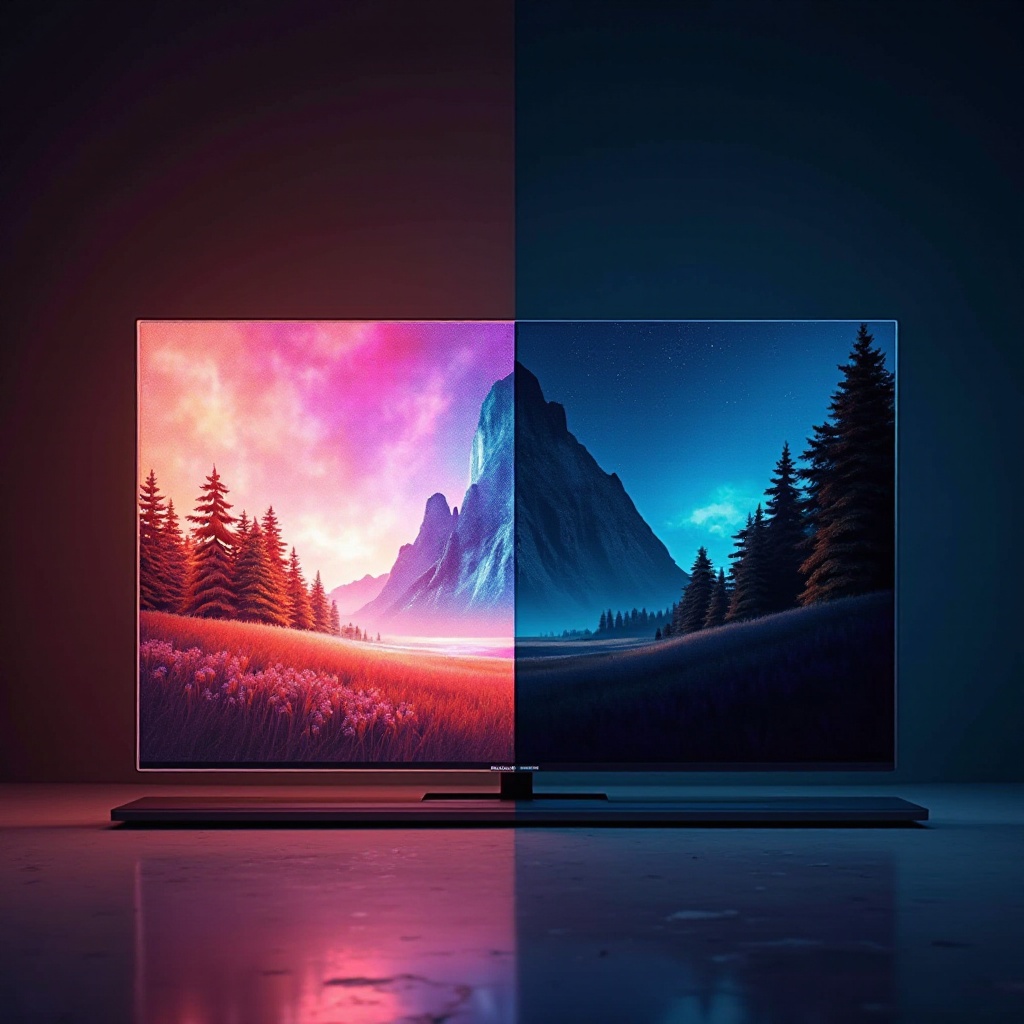
Selecting between QLED and OLED TVs requires investigating your personal viewing circumstances.
QLED TVs thrive in environments with lots of ambient light, while OLED TVs are more suitable for darker settings where their deep blacks can be appreciated.
Budget considerations also play a significant role, as OLED TVs are usually more expensive than QLED due to advanced technology, although the price gap is narrowing, offering more buying options.
Finally, personal viewing preferences must be factored in. If you often watch TV in a dark room, OLED may be ideal. For regular daytime viewing, QLED’s brightness could be advantageous. Think about factors like color accuracy, contrast, and brightness for your preferences.
The choice between QLED and OLED truly depends on personal preferences and practical needs. Evaluating these factors helps ensure that you make a valuable decision that meets your expectations.
In summarizing the key points, readers can easily assess the fundamental differences between QLED and OLED technologies, assisting in making an appropriate choice for 2024. Considerations include viewing environment, budget constraints, and personal preferences. Both QLED and OLED have distinct strengths and weaknesses, but being informed about their technical aspects makes identifying the right option for your lifestyle straightforward.
Frequently Asked Questions
Is OLED better than QLED for dark rooms?
OLED is superior in dark environments due to its ability to display perfect blacks and high contrast ratios without a backlight, providing an immersive viewing experience.
Do OLED TVs last longer than QLED TVs?
QLED TVs typically exhibit longer lifespans as they’re less prone to burn-in. However, advancements are improving OLED lifespan significantly.
Which technology is more energy-efficient, QLED or OLED?
OLED often uses less power since it does not rely on a backlight and each pixel can turn off completely. QLED may consume more power due to its brightness levels.